The agile4d-assessment is a project I am developing as part of my doctoral studies at the Vienna University of Economics and Business (WU Wien). Please find explanations for the most important parts of my research below.
Agility…
…endless definitions – 12 challenges – numerous approaches
Although there’s a broad and diverse understanding of what agility is or what needs to be done to become agile, the purpose is clear: The Agile Manifesto describes 12 Principles that should guide organizations that attempt to be agile. In fact, all of these principles can be seen as challenges too, and so organizations develop approaches to address the principles and their underlying challenges. Solutions developed to ‘satisfy customers with early and regular delivery of valuable products’ show both variation and similarity.
The agile4d-assessment tries to understand the patterns organizations develop to align
- their business goals,
- the selection of practices,
- the use of practices,
- in their given context.
Only if organizations align their business goals with the goal of their agile transformation and the other dimensions mentioned can they leverage agility as a corporate success factor.
The importance of patterns
Patterns describe recurring problems and the core of their solution. A deeper understanding of such patterns supports organizational development, as they
- inform us about the organizational context,
- are specific enough to inform educated users and guide them on how to handle related situations,
- are generic enough to be adjusted according to organizations’ needs.
Therefore a good understanding of organizational patterns supports faster and thus enables more efficient and effective learning.
The range and usage of patterns is fairly broad: They may describe how teams can better incorporate customer feedback in product development or may provide options on how to decentralize decision-making and increase flexibility. However, they provide orientation and help to create order when things are in flux.
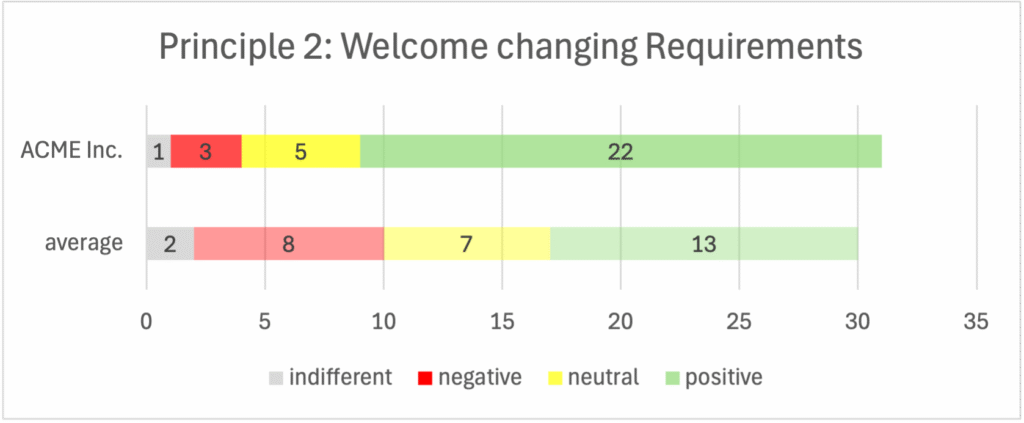
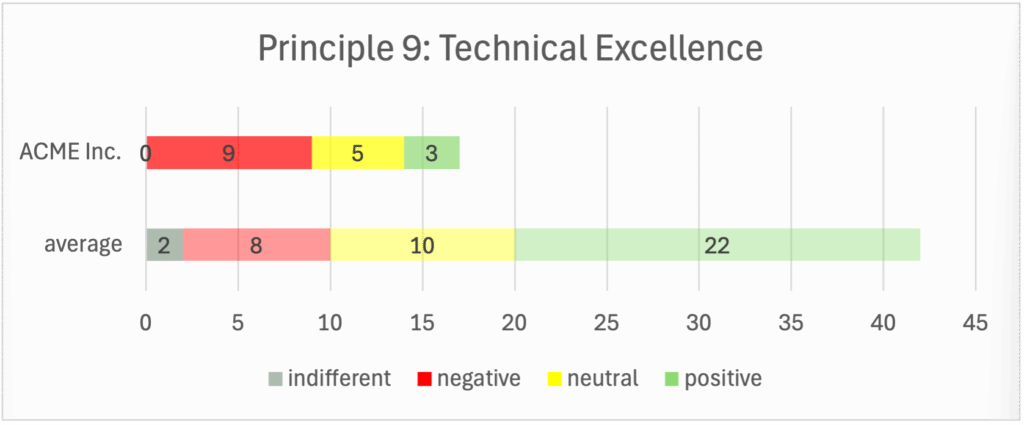
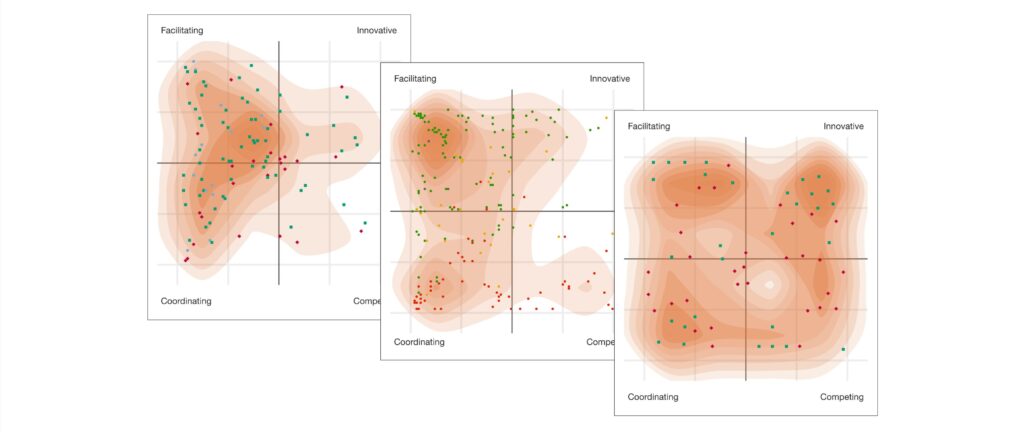
Culture for breakfast
Agile? That was doing twice the work in half the time, right? Or was it all about cross-functional, self-organized teams that solve complex problems pretty flexible? Are you expecting empirical process control or shall teams focus on how to validate new ideas and hypotheses quickly?
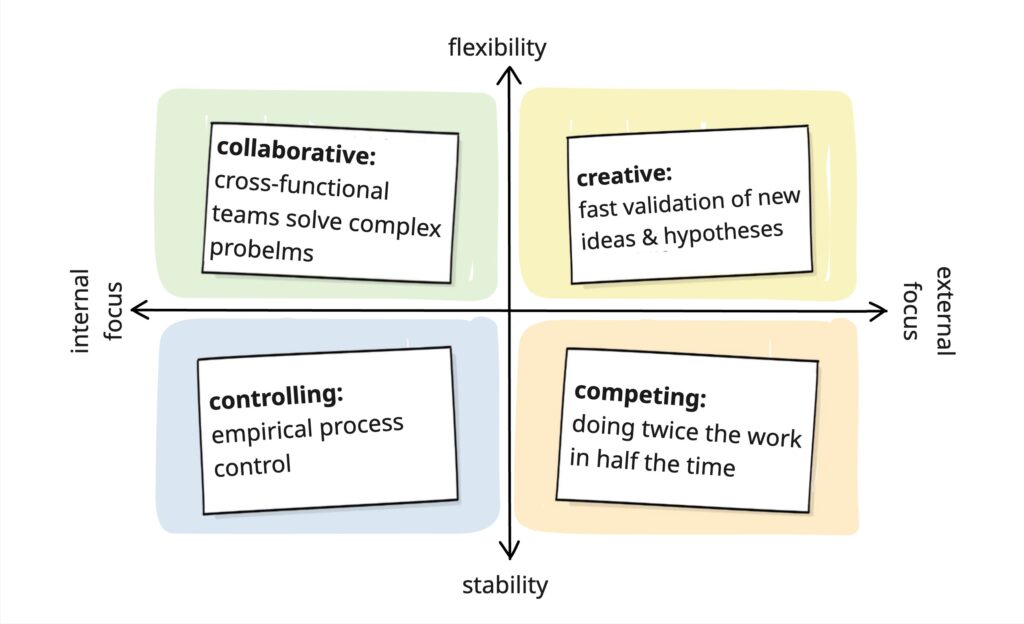
The way how agile transitions go in practice reminds us of Peter Drucker’s quote: “Culture eats strategy for breakfast.” – Your personal understanding of agility shapes your expectation. But if different expectations and implementation don’t align, you may recognize that your agile transition gets stuck or even goes in a completely different direction than you thought at the beginning.
Our own cultural disposition determines not only what we actually mean when we talk about agility, but also which patterns are even feasible for us. In practice, a lack of appropriate reflection loops leads to unspoken or unmet expectations resulting in increasing dissatisfaction among teams and/or sponsors of agile transitions.
And this is, where sensemaking comes in: It allows teams and organizations to reflect their expectations and map them to what was put in practice.
Sensemaking?
Sensemaking describes how people make sense of their environment and move to action. It is an ongoing, recurring process that includes sensing, interpretation and judgment. While sensemaking usually runs unconsciously, it comes to the center of our attention, whenever we fail to make sense of what happens around us – for example when known patterns and explanations don’t match.
Whenever multiple people cooperate, it requires collaborative sensemaking. Just like sensemaking itself, the distinction between good and bad sensemaking sometimes stays unconscious:
If a group receives a task but everyone defines and approaches their own solution, this indicates poor sensemaking.
Whenever a group is able to incorporate different perspectives on their challenge ahead and is able to come up with a joint plan, they do good sensemaking. While sensemaking is a capability that can be trained, it is also the foundation of successful cross-functional teams that can leverage their diversity.
Used as a scientific methodology, it helps us examine the sensemaking within groups, uncover unknown or subconscious structures, and make weak signals and tacit knowledge transparent. That way it informs tactics and strategies for organizational development.
What’s in it for us?
After completing the empirical research I’d like to connect participants who contributed to the study. This will allow you to exchange insights on the results of your individual assessments and learn about useful patterns others already successfully apply. This exchange is an invitation, but not an obligation, and shall be based on individual participation.
Data Privacy!
The collection of data for this research project is completely anonymous, in accordance with the General Data Protection Regulation (GDPR) and the Austrian Federal Data Protection Act. Furthermore, the data analysis is conducted according to scientific standards and without the use of LLMs, GPTs, or other forms of artificial intelligence. If you have any questions regarding data privacy, do not hesitate to get in touch with the author of the study directly.